NO UPCOMING EVENTS

Tuesday, February 15, 2011

Eye Charts

  • Classic Eye Chart: Joel Schneider's 3-page Snellen Chart plus near vision testing card
  • Modern Standard: ETDRS charts based on those provided on the National Eye Institute's charts page. The following charts have correctly-labelled lines from 40ft to 2ft suitable for printing on letter sized paper, and feature vector graphics for a sharper image (unlike the maximum 300dpi, not-to-scale charts provided by the N.E.I.).
  • Interactive Eye Chart: Alejandro Saksida's Flash-based Ultimate Random Snellen Chart generator, version 3.1 (updated January 12, 2006):
  • Vision Training Charts from Ray Gottlieb, O.D., Ph.D., with instructions.
  • Alex Eulenberg's 1-page Snellen Chart (20/20)
    • in GIF format (browser-viewable, also printable at 72 dpi)
    • in Macintosh PICT format (hi-resolution, downloadable & printable)
    • in Encapsulated PostScript (.eps) format (compatible with, among other programs, WordPerfect for Windows.)
    • in PDF format.
  • Vic Cinc's Letter rows & grid of random tumbling E's
  • Vic Cinc's Astigmatic mirror
  • Egidio Rizzi's Vision Charts for Eyesight Improvement -- 10 charts for practicing fusion, convergence, divergence, with notes on each exercise's applicability for nearsightedness, farsightedness, and astigmatism.

Make your own eye chart!

For those enterprising souls out there who would like to laserprint or draw by hand their own eye chart, or if you would like to verify that your printout is of the correct proportions, here are the specs:
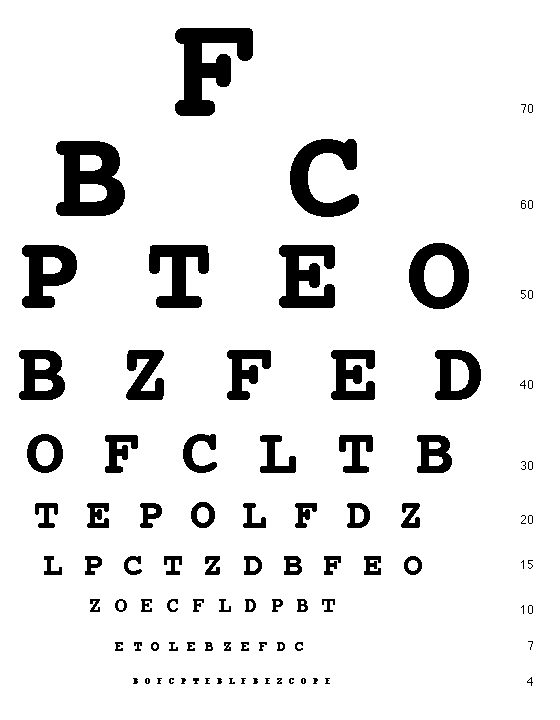
Distance (feet)  70   60    50    40    30    20    15    10    7    4
letter ht (mm)   31   27    22    18    13     9     7     4    3    2
letter ht (pt)   88   76    63    50    38    25    19    13    9    5
font size (pt)  152  130   108    87    65    43    33    21   15    9
With the University at Buffalo's Interactive Visual Acuity Chart, you can display the letters or symbols for a specified Snellen line on your computer monitor at exactly the right size (note: you must follow the instructions for calibration).

Interpreting the table

"Distance" in the above table refers to the furthest distance from the chart at which a normal eye is able to read the letter. On a Snellen eye chart, rows of letters of a given size have the corresponding distance number next to them. Thus the row of 18mm letters is marked "40". The font must be Courier (or Courier Bold) in order for the "font size" in points to correspond to the indicated letter height. Courier Bold is the PostScript font that most closely approximates the official Snellen letters.

Visual Acuity

by Wendy Strouse Watt, O.D.
October 2003
A standard eye chart is necessary to make comparisons and to record people's visual acuity. The most common chart used in most doctors' offices is the Snellen eye chart. In 1862, a Dutch Ophthalmologist, Dr. Hermann Snellen, devised this eye chart. He determined that there was a relationship between the sizes of certain letters viewed at certain distances. A copy of the Snellen chart may be found here.
The Snellen eye chart has a series of letters or letters and numbers, with the largest at the top. As the person being tested reads down the chart, the letters gradually become smaller. Many other versions of this chart are used for people who cannot read the alphabet. The Tumbling E chart has the capital letter "E" facing in different directions and the person being tested must determine which direction the "E" is pointing, up, down, left, or right. A Broken Wheel vision test is one that can be used for children or those who cannot read the alphabet and the person being tested must tell which card has the broken wheels on the pictured car. Another type of eye chart that can be used is a picture chart with common pictures of different sizes. In research, another chart, the ETDRS chart, has become the standard. Originally, the chart was used in the Early Treatment of Diabetic Retinopathy Study.
The Snellen fractions, 20/20, 20/30, etc., are measures of sharpness of sight. They relate to the ability to identify small letters with high contrast at a specified distance. They give no information about seeing larger objects and objects with poor contrast (such as steps and curbs); it also does not inform us as to whether or not meaning is obtained from visual input, how much effort is needed to see clearly or singly, and whether or not vision is less efficient when using both eyes as opposed to each eye individually. In short, visual acuity measures only the smallest detail we can see; it does not represent the quality of vision in general.
August Colenbrander, M.D. (Smith-Kettlewell Eye research Institute and California Pacific Medical Center) offers a good explanation of acuity measurement. He says: "If a subject needs letters (or symbols) that are twice as large or twice as close as those that can just be seen by a standard eye, visual acuity is said to be 1/2 (or an equivalent fractional value, such as 20/40, 6/12, etc.). If the magnification need is 5x, visual acuity is 1/5 (20/100, 6/30, etc.), and so on."
Dr. Colenbrander also emphasizes that, contrary to popular belief, 20/20 is not actually normal or average, let alone perfect, acuity. Snellen, he says, established it is a reference standard. Normal acuity in healthy adults is one or two lines better. Average acuity in a population sample does not drop to the 20/20 level until age 60 or 70. This explains the existence of the two lines smaller than 20/20: 20/15 and 20/10.
When checking visual acuity, one eye is covered at a time and the vision of each eye is recorded separately, as well as both eyes together. In the Snellen fraction 20/20, the first number represents the test distance, 20 feet. The second number represents the distance that the average eye can see the letters on a certain line of the eye chart. So, 20/20 means that the eye being tested can read a certain size letter when it is 20 feet away. If a person sees 20/40, at 20 feet from the chart that person can read letters that a person with 20/20 vision could read from 40 feet away. The 20/40 letters are twice the size of 20/20 letters; however, it does not mean 50% vision since 20/20 sounds like it is one half of 20/40. If 20/20 is considered 100% visual effiency, 20/40 visual acuity is 85% efficient.
If a patient sees 20/200, the smallest letter that they can see at 20 feet could be seen by a normal eye at 200 feet. This is the Snellen Acuity (English). In Metric Acuity, 20/20 equals 6/6. The conversion is that 20 feet equals approximately 6 meters (actually 6.096).

Metric 6/3
6/4.5
6/6
6/7.5
6/9
6/12
6/15
6/30
6/60
Snellen 20/10
20/15
20/20
20/25
20/30
20/40
20/50
20/100
20/200
For people who have worse than 20/400 vision, a different eye chart can be used that measures beyond 20/400 vision, or, for the most accurate measurements, a Low Vision Chart can be moved closer to the patient to measure the smallest letter that they can see at a lesser distance. It is common to record vision worse than 20/400 as Count Fingers (CF at a certain number of feet), Hand Motion (HM at a certain number of feet), Light Perception (LP), or No Light Perception (NLP). The conversion of Snellen Acuity to Count Fingers Acuity is as follows:

20/800
20/1000
20/1143
20/1333
20/1600
20/2000
20/2666
20/4000
20/8000
CF10' (Count Fingers at ten feet)
CF 8'
CF 7'
CF 6'
CF 5'
CF 4'
CF 3'
CF 2'
CF 1'
Prescriptions for eyeglasses are measured in diopters. The measurement starts at zero ("plano"), with four quarters to a diopter: 0.25 (a quarter diopter), 0.50 (one half a diopter), 0.75 (3/4 of a diopter), and 1.00 (one diopter). The higher the numbers, the higher (stronger) the prescription.Here are estimates for the approximate correction needed for each line seen on the Snellen chart:

Snellen 20/10
20/15
20/20
20/30
20/40
20/50
20/100
20/200
Estimated prescription Plano (zero)
Plano
Plano to -0.25
-0.50
-0.75
-1.00 to -1.25
-1.75 to -2.00
-2.00 to -2.50
This estimation works best for myopia (nearsightedness) because hyperopic (farsighted) people can focus and compensate for a certain amount of their prescription. The Snellen fractions cannot be used for ordering a pair of glasses or contacts that will correct a person's vision.
Legal Blindness is when a person's best-corrected vision is 20/200 or worse. If a person is legally blind, they can qualify for tax breaks and certain federal and state social services, such as help in purchasing magnifiers and other low vision aids.

Snellen charts 
This is the same chart that your doctor uses to determine your visual acuity. The normal height for the letter A is 88 mm, and the viewing distance is 6 meters.
To properly view the chart on your monitor:

  • Measure the height of the letter A in millimeters.
  • Divide by 88.
  • Multiply by 6.
The final number is the distance (in meters) that you should stand from the monitor. For information on using the chart to determine your visual acuity, see "How Visual Acuity Is Measured" in the MD Support Library.


image of Snellen chart

Friday, July 16, 2010

The Optometric Oath

With full deliberation I freely and solemnly pledge that: I will practice the art and science of optometry faithfully and conscientiously, and to the fullest scope of my competence. I will uphold and honorably promote by example and action the highest standards, ethics and ideals of my chosen profession and the honor of the degree, Doctor of Optometry, which has been granted me.

I will provide professional care for those who seek my services, with concern, with compassion and with due regard for their human rights and dignity.

I will place the treatment of those who seek my care above personal gain and strive to see that none shall lack for proper care.

I will hold as privileged and inviolable all information entrusted to me in confidence by my patients.

I will advise my patients fully and honestly of all which may serve to restore, maintain or enhance their vision and general health.

I will strive continuously to broaden my knowledge and skills so that my patients may benefit from all new and efficacious means to enhance the care of human vision.

I will share information cordially and unselfishly with my fellow optometrists and other professionals for the benefit of patients and the advancement of human knowledge and welfare. I will do my utmost to serve my community, my country and humankind as a citizen as well as an optometrist.

I hereby commit myself to be steadfast in the performance of this my solemn oath and obligation.


--
Tanvir Akhtar
BS(Hons) Optometry
Pakistan

Code of Ethics

It shall be the ideal, resolve, and duty of all optometrists:

TO KEEP their patients' eye, vision, and general health paramount at all times;

TO RESPECT the rights and dignity of patients regarding their health care decisions;

TO ADVISE their patients whenever consultation with, or referral to another optometrist or other health professional is appropriate;

TO ENSURE confidentiality and privacy of patients' protected health and other personal information;

TO STRIVE to ensure that all persons have access to eye, vision, and general health care;

TO ADVANCE their professional knowledge and proficiency to maintain and expand competence to benefit their patients;

TO MAINTAIN their practices in accordance with professional health care standards;

TO PROMOTE ethical and cordial relationships with all members of the health care community;

TO RECOGNIZE their obligation to protect the health and welfare of society; and

TO CONDUCT themselves as exemplary citizens and professionals with honesty, integrity, fairness, kindness and compassion

Adopted by the House of Delegates as:
Substantive Motion M-1944-1, June 1944; Modified June 2005; Repealed June 2007
Modified and Adopted as Resolution #1969, June 2007


--
Tanvir Akhtar
BS(Hons) Optometry
Pakistan

Wednesday, July 7, 2010

Job Descriptions

Job Descriptions approved by the National Steering Committee for the prevention and control of blindness in Pakistan.


Ophthalmic Technician (Level I)
Minimum of one year time training in an accredited institution.
should make an important team member with the ophthalmologist;
note down the presenting complaints of the patients;
Ask the patient about common systemic diseases like diabetes, hypertension;
Ask the patient about the family history of common eye and systemic disease
(cataract, glaucoma, corneal, diabetes and hypertension)
Ask the patient about the use of any drug and allergy or hyper-sensitivity to any drug;
Detection and referral of common causes of blindness and visual impairment;
Health education and counseling;
Prescribe Vitamin A capsule/drops and Tetracycline, as appropriate;
Can use mydratics and local anesthetic with caution and responsibility
as advised by ophthalmologist;
Can remove superficial conjunctival foreign bodies
Can assess visual acuity for near and far, use pinhole, measure IOP,
and use of auto-refract meter;
Assist the Ophthalmologist in the operation theater and out-patient department;
Basic care and maintenance of ophthalmic equipments;
Maintain the record of ophthalmic unit manually and computerized;
Participation in community based eye health programs like school eye health,
trachoma control program, prevention of childhood blindness program etc.

Refractionist (Level II)
Minimum of two years full time training in an accredited institution
Can perform all the functions of level I;
Carry out refraction of all patients whose visual acuity improves with pinhole;
Assess the refractive state of a child 3 years and above using cycloplegic agent;
Basic vision function assessment including assessment of visual fields, contrast
and binocular visual function; contrast sensitivity
Screening of ocular pathologies at out patient department/ field and referral to
appropriate specialist;
Be able to carry out basic fundus examination using a direct Ophthalmoscope.
Performs any other relative assignment by the department;
Maintain records of ophthalmic unit and reporting;
Supervise school and community eye health screening programmes;
Coordinate and impart training to primary health workers and teachers;
Contribute to the eye health promotion activities;
Contribute to eye health and blindness surveys;
Carry out basic low vision assessment and prescribe LVDs from a defined range.

Optometrist (Level III)
Minimum of four year's full time training leading to
a university degree in an accredited institution
World Council of Optometry (WCO) defines optometrist as follows:
Optometrists are the primary health care practitioners of the eye and
visual system who provide comprehensive eye and vision care, which
includes refraction and dispensing detection/diagnosis and management of
diseases in the eye, and the rehabilitation of conditions of the visual system."
In the light of the above, the following job description is recommended for Pakistan.
Can perform all the functions of level II
Can perform the additional skills acquired:
Advanced refraction including refraction of all children
Low vision assessment
Prescribe hard and soft contact lens
Carry out advance visual function assessment
Detection/diagnosis and referral of diseases of eye
Can act as faculty member and trainer for level I and I
and other relevant cadres
Engage in operational and field research;
manage record keeping, analysis, and reporting;
Participate and lead on various eye campaigns.

Orthoptists (Level III)
Orthoptic assessment and non surgical management;
Visual function assessment especially in children;
Pediatric refraction / assessment including cycloplegic refraction;
Engage in research related to BSV anomalies;
Performs any other relevant field of expertise;
Record keeping and reporting.

Ophthalmic Technologist (Level III)
Assist ophthalmologist in LASER;
Perform the Diagnostic procedures like FFA (in presence of a doctor), A& B-Scan
Biometry, Perimetry Electrophysiological test and any other non-invasie advanced diagnostic procedures.
Maintenance of instrument & equipments.
Engage in operational and field research;
Teaching and training in the relevant field;
Perform any other relevant assignment by the department;
Record keeping an


Muhammad Rashid
Optometrist
Contact Lens Clinic
Al-Shifa Trust Eye Hospital
Rawalpindi
Pakistan
+923332645162

Monday, July 5, 2010

Pakistan Optometric Conference Submission of Abstracts

My Dear All Members!

Submission of Abstracts and Call for Papers!

The first Pakistan Optometric Conference is
schedules to be held on 27-28th Nov 2010,
 in Rawalpindi /Islamabad.


Abstract submission for conference is open now.

Deadline for Abstract submission is 31st August 2010.

Muhammad Rashid
Optometrist


Your E-mail and More On-the-Go. Get Windows Live Hotmail Free. Sign up now.

Sunday, July 4, 2010

Latest POA membership info

Mr Rizwan Elahi
Mr Nasir Iqbal
Mr Faisal Nadeem
joined POA

Muhammad Rashid
Optometrist
Contact Lens Clinic
Al-Shifa Trust Eye Hospital
Rawalpindi
Pakistan
+923332645162


Your E-mail and More On-the-Go. Get Windows Live Hotmail Free. Sign up now.

Friday, June 18, 2010

Optometrists

Significant Points


  • Admission to optometry school is competitive; only about 1 in 3 applicants was accepted in 2007 in USA.
  • Graduation from an accredited college of Optometry and a State license administered by the National Board of Examiners in Optometry are required.
  • Employment is expected to grow much faster than the average in response to the vision care needs of a growing and aging population.
  • Job opportunities are likely to be excellent.

Nature of the Work About this section

Optometrists, also known as doctors of optometry, or ODs, are the main providers of vision care. They examine people's eyes to diagnose vision problems, such as nearsightedness and farsightedness, and they test patients' depth and color perception and ability to focus and coordinate the eyes. Optometrists may prescribe eyeglasses or contact lenses, or they may provide other treatments, such as vision therapy or low-vision rehabilitation.
Optometrists also test for glaucoma and other eye diseases and diagnose conditions caused by systemic diseases such as diabetes and high blood pressure, referring patients to other health practitioners as needed. They prescribe medication to treat vision problems or eye diseases, and some provide preoperative and postoperative care to cataract patients, as well as to patients who have had corrective laser surgery. Like other physicians, optometrists encourage preventative measures by promoting nutrition and hygiene education to their patients to minimize the risk of eye disease.
Although most work in a general practice as a primary care optometrist, some optometrists prefer to specialize in a particular field, such as contact lenses, geriatrics, pediatrics, or vision therapy. As a result, an increasing number of optometrists are forming group practices in which each group member specializes in a specific area while still remaining a full scope practitioner. For example, an expert in low-vision rehabilitation may help legally blind patients by custom fitting them with a magnifying device that will enable them to read. Some may specialize in occupational vision, developing ways to protect workers' eyes from on-the-job strain or injury. Others may focus on sports vision, head trauma, or ocular disease and special testing. A few optometrists teach optometry, perform research, or consult.
Most optometrists are private practitioners who also handle the business aspects of running an office, such as developing a patient base, hiring employees, keeping paper and electronic records, and ordering equipment and supplies. Optometrists who operate franchise optical stores also may have some of these duties.
Optometrists should not be confused with ophthalmologists or dispensing opticians. Ophthalmologists are physicians who perform eye surgery, as well as diagnose and treat eye diseases and injuries. Like optometrists, they also examine eyes and prescribe eyeglasses and contact lenses. Dispensing opticians fit and adjust eyeglasses and, in some States, may fit contact lenses according to prescriptions written by ophthalmologists or optometrists. (See the sections on physicians and surgeons; and opticians, dispensing, elsewhere in the Handbook.)
Work environment. Optometrists usually work in their own offices that are clean, well lighted, and comfortable. Although most full-time optometrists work standard business hours, some work weekends and evenings to suit the needs of patients. Emergency calls, once uncommon, have increased with the passage of therapeutic-drug laws expanding optometrists' ability to prescribe medications.
The  Doctor of Optometry degree requires the completion of a 4-year program  at an accredited optometry school.
The Doctor of Optometry degree requires the completion of a 4-year program at an accredited optometry school.

Training, Other Qualifications, and Advancement About this section

The Doctor of Optometry degree requires the completion of a 4-year program at an accredited school of optometry, preceded by at least 3 years of preoptometric study at an accredited college or university. All States require optometrists to be licensed.
Education and training. Optometrists need a Doctor of Optometry degree, which requires the completion of a 4-year program at an accredited school of optometry. In 2009, there were 19 colleges of optometry in the U.S. and 1 in Puerto Rico that offered programs accredited by the Accreditation Council on Optometric Education of the American Optometric Association. Requirements for admission to optometry schools include college courses in English, mathematics, physics, chemistry, and biology. Because a strong background in science is important, many applicants to optometry school major in a science, such as biology or chemistry, as undergraduates. Other applicants major in another subject and take many science courses offering laboratory experience.
Admission to optometry school is competitive; about 1 in 3 applicants was accepted in 2007. All applicants must take the Optometry Admissions Test (OAT), a standardized exam which measures academic ability and scientific comprehension. The OAT consists of four tests: survey of the natural sciences, such as biology, general chemistry, and organic chemistry; reading comprehension; physics; and quantitative reasoning. As a result, most applicants take the test after their sophomore or junior year in college, allowing them an opportunity to take the test again and raise their score. A few applicants are accepted to optometry school after 3 years of college and complete their bachelor's degree while attending optometry school. However, most students accepted by a school or college of optometry have completed an undergraduate degree. Each institution has its own undergraduate prerequisites, so applicants should contact the school or college of their choice for specific requirements.
Optometry programs include classroom and laboratory study of health and visual sciences and clinical training in the diagnosis and treatment of eye disorders. Courses in pharmacology, optics, vision science, biochemistry, and systemic diseases are included.
One-year postgraduate clinical residency programs are available for optometrists who wish to obtain advanced clinical competence within a particular area of optometry. Specialty areas for residency programs include family practice optometry, pediatric optometry, geriatric optometry, vision therapy and rehabilitation, low-vision rehabilitation, cornea and contact lenses, refractive and ocular surgery, primary eye care optometry, and ocular disease.
Licensure. All States and the District of Columbia require that optometrists be licensed. Applicants for a license must have a Doctor of Optometry degree from an accredited optometry school and must pass both a written National Board examination and a National, regional, or State clinical examination. The written and clinical examinations of the National Board of Examiners in Optometry usually are taken during the student's academic career. Many States also require applicants to pass an examination on relevant State laws. Licenses must be renewed every 1 to 3 years and, in all States, continuing education credits are needed for renewal.
Other qualifications. Business acumen, self-discipline, and the ability to deal tactfully with patients are important for success. The work of optometrists also requires attention to detail and manual dexterity.
Advancement. Optometrists who wish to teach or conduct research may study for a master's degree or Ph.D. in visual science, physiological optics, neurophysiology, public health, health administration, health information and communication, or health education.

Employment About this section

Optometrists held about 34,800 jobs in 2008. Salaried jobs for optometrists were primarily in offices of optometrists; offices of physicians, including ophthalmologists; and health and personal care stores, including optical goods stores. A few salaried jobs for optometrists were in hospitals, the Federal Government, or outpatient care centers, including health maintenance organizations. About 25 percent of optometrists are self-employed. According to a 2008 survey by the American Optometric Association, most self-employed optometrists worked in private practice or in partnership with other healthcare professionals. A small number worked for optical chains or franchises or as independent contractors.

Job Outlook About this section

Employment of optometrists is expected to grow much faster than the average for all occupations through 2018, in response to the vision care needs of a growing and aging population. Excellent job opportunities are expected.
Employment change. Employment of optometrists is projected to grow 24 percent between 2008 and 2018. A growing population that recognizes the importance of good eye care will increase demand for optometrists. Also, an increasing number of health insurance plans that include vision care should generate more job growth.
As the population ages, there will likely be more visits to optometrists and ophthalmologists because of the onset of vision problems that occur at older ages, such as cataracts, glaucoma, and macular degeneration. In addition, increased incidences of diabetes and hypertension in the general population as well as in the elderly will generate greater demand for optometric services as these diseases often affect eyesight.
Employment of optometrists would grow more rapidly if not for productivity gains expected to allow each optometrist to see more patients. These expected gains stem from greater use of optometric assistants and other support personnel, who can reduce the amount of time optometrists need with each patient.
The increasing popularity of laser surgery to correct some vision problems was previously thought to have an adverse effect on the demand for optometrists as patients often do not require eyeglasses afterward. However, optometrists will still be needed to provide preoperative and postoperative care for laser surgery patients, therefore laser eye surgery will likely have little to no impact on the employment of optometrists.
Job prospects. Excellent job opportunities are expected over the next decade because there are only 19 schools of optometry in the United States, resulting in a limited number of graduates—about 1,200—each year. This number is not expected to keep pace with demand. However, admission to optometry school is competitive.
In addition to job growth, the need to replace optometrists who retire will also create many employment opportunities. According to the American Optometric Association, nearly one-quarter of practicing optometrists are approaching retirement age. As they begin to retire, many opportunities will arise, particularly in individual and group practices.

Projections Data About this section

Projections data from the National Employment Matrix
Occupational Title
SOC Code
Employment, 2008
Projected
Employment, 2018
Change,
2008-18
Detailed Statistics
Number
Percent
Optometrists
29-1041
34,800 43,200 8,500 24
[PDF]
[XLS]
    NOTE: Data in this table are rounded. See the discussion of the employment projections table in the Handbook introductory chapter on Occupational Information Included in the Handbook.

Earnings About this section

Median annual wages of salaried optometrists were $96,320 in May 2008. The middle 50 percent earned between $70,140 and $125,460. Median annual wages of salaried optometrists in offices of optometrists were $92,670. Salaried optometrists tend to earn more initially than do optometrists who set up their own practices. In the long run, however, those in private practice usually earn more.
According to the American Optometric Association, average annual income for self-employed optometrists was $175,329 in 2007.
Self-employed optometrists, including those in individual, partnerships, and group practice, continue to earn higher income than those in other settings. Earnings also vary by group size. For example, practitioners in large groups—six or more—earn $159,300; practitioners in mid-sized groups—three to five people—earn $179,205; those in small practices—two people—earn $176,944; and individual practitioners earn an average of $134,094. Self-employed optometrists must also provide their own benefits. Practitioners associated with optical chains earn $100,704 on average. However, they typically enjoy paid vacation, sick leave, and pension contributions.


--
Tanvir Akhtar
BS(Hons) Optometry
Pakistan

Thursday, June 3, 2010

General body meeting of POA

General Body Meeting of
Pakistan Optometric Association was
held on 13 June 2010 at Mayo hospital Lahore


posted by
Muhammad Rashid
Optometrist


Hotmail: Powerful Free email with security by Microsoft. Get it now.

Provincial Up Date Of Member

Provincial Centers update

Alshifa trust eye hospital

Regular member    45

Student member    10

It is duty of  Mr. Farman to encourage

student for POA membership

Pico, Peshawar

Regular member    33

Student member    22

 Pipo Lahore

Regular member   27

Student member   07

Al Ibrahim, Karachi

Regular member   04

Student member   55


posted by
Muhammad Rashid
Optometrist


Hotmail: Powerful Free email with security by Microsoft. Get it now.

Rugular Member Update

1 Madam Nusrat From Shifa International
2 Mr Mehar Wali Khan From RMC
3 Miss Afshan Hassan Student 4th Year
Bsc optometry & orthoptic joined POA
posted by
Muhammad Rashid
Optometrist


Hotmail: Trusted email with Microsoft's powerful SPAM protection. Sign up now.

Tuesday, May 18, 2010

Student Membership Info

  1.  Miss Kalsoom Rani  (4th year student  Bsc Optom. & ortho.)
  2.  Miss Amna Nawaz  (1st year student  Bsc Optom. & ortho)      
  3. Miss Uzma Tabassum  (1st year student  Bsc Optom. & ortho)  
  4. Mr M. Abuzar Ghaffari  (1st year student  Bsc Optom. & ortho)

posted by

Muhammad Rashid
Optometrist

Wednesday, May 12, 2010

student membership info

Muhammad Ahmed  4th year Student BSc optometry & orthoptic
Ammara Aslam       4th year Student BSc optometry & orthoptic
Waseem sajjad      3rd year Student BSc optometry & orthoptic
Shujaat Hussain     1st year Student BSc optometry & orthoptic
Muhammad Yasin   1st year Student BSc optometry & orthoptic
JOINED POA TODAY

Muhammad Rashid
Optometrist


Hotmail: Trusted email with powerful SPAM protection. Sign up now.

Friday, April 16, 2010

Membership Info

Miss Shazia Nazir joined POA

Muhammad Rashid
Optometrist


Hotmail: Free, trusted and rich email service. Get it now.

Sunday, April 11, 2010

POA Registration

Mr Nasir Ameer From MMH Joins POA
posted by
Muhammad Rashid
Optometrist


Hotmail: Free, trusted and rich email service. Get it now.

Tuesday, February 23, 2010

Membership Info

Mr Khurram Shahzad From MMH Chakwal joins POA
posted by
Muhammad Rashid
Optometrist


Hotmail: Trusted email with Microsoft's powerful SPAM protection. Sign up now.

Friday, January 29, 2010

Primary Eyecare in the Community

http://www.assoc-optometrists.org/uploaded_files/primary_eyecare_in_the_community.pdf

Optometrist vs Ophthalmologist, Do You Know The Difference?


An Optometrist is a health care professional who is licensed to provide primary eye care services:

  • to examine and diagnose eye diseases such as glaucoma, cataracts, and retinal diseases and, in certain states in the U.S., to treat them;

  • to diagnose related systemic (bodywide) conditions such as hypertension and diabetes that may affect the eyes;

  • to examine, diagnose and treat visual conditions such as nearsightedness, farsightedness, astigmatism and presbyopia; and

  • to prescribe glasses, contact lenses, low vision rehabilitation and medications as well as perform minor surgical procedures such as the removal of foreign bodies.

An optometrist is a Doctor of Optometry, an O.D.. To become an optometrist, one must complete pre-professional undergraduate college education followed by 4 years of professional education in a college of optometry. Some optometrists also do a residency.

An Ophthalmologist is an eye M.D., a medical doctor who is specialized in eye and vision care. Ophthalmologists are trained to provide the full spectrum of eye care, from prescribing glasses and contact lenses to complex and delicate eye surgery. They may also be involved in eye research.

After 4 years of medical school and a year of internship, every ophthalmologist spends a minimum of 3 years of residency (hospital-based training) in ophthalmology. During residency, the eye M.D. receives special training in all aspects of eye care, including prevention, diagnosis and medical and surgical treatment of eye conditions and diseases. An ophthalmologist may spend an additional year or two in training in a subspecialty, that is, a specific area of eye care.

Thursday, January 14, 2010

Defination of Optometrist by WHO

World Health Organization- a definition of Optometry:
Optometry is a health care profession that is autonomous, educated, and regulated (licensed/registered), and optometrists are the primary health care practitioners of the eye and visual system who provide comprehensive eye and vision care, which includes refraction and dispensing, detection/diagnosis and management of disease in the eye, and the rehabilitation of conditions of the visual system

Thursday, January 7, 2010